


The Handmaid’s Tale: The Complete Series review by Drusilla Blakey
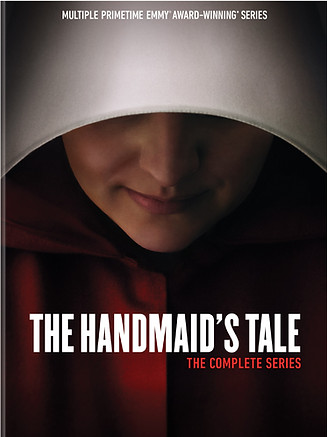
One of the most critically acclaimed series in years, The Handmaid’s Tale hit Hulu back in 2017 starring Elisabeth Moss, Yvonne Strahovski, Bradley Whitford, Max Minghella, Ann Dowd, O-T Fagbenle, Samira Wiley, Madeline Brewer, Amanda Brugel, Sam Jaeger, Ever Carradine, and Josh Charles. After numerous awards and an announced sequels series the show finally ended its run after six seasons. Now fans can bring the complete series home on DVD to relive it all over again.
The Handmaid’s Tale follows the story of life in the dystopia of Gilead, a totalitarian society in what was formerly the United States. Offred (Elisabeth Moss), one of the few fertile women known as Handmaids in the oppressive Republic of Gilead, struggles to survive as a reproductive surrogate for a powerful Commander and his resentful wife.
The series is haunting and visually striking that captivated me from the very beginning. What stood out most were the characters; each of them carried contradictions that made their struggles feel real, and I found myself both frustrated by their choices and moved by their resilience. It was difficult yet compelling to watch these characters make decisions, sometimes for better or
worse, under impossible circumstances and in unbelievable situations.
Season 1 closely follows Margaret Atwood’s novel, capturing the chilling world of Gilead. From Season 2 onward, however, the series ventures into new territory, expanding the storylines and introducing fresh conflicts that kept viewers on the edge of their seats. It was fascinating to see how certain personalities diverged from the book, offering new dimensions to familiar characters while staying true to the spirit of Atwood’s vision as she consulted on the show.
The costumes and the extravagant use of color were unforgettable. The stark reds of the handmaids, the muted blues of the wives, and the austere blacks of the commanders created a visual language that reinforced the rigid class system of Gilead. These choices weren’t just aesthetic; they became symbols of power, oppression, and resistance.
June’s journey was the emotional core of the series for me. She began as a seemingly weak character, trapped and silenced, but gradually transformed into a fierce leader. Her strength in the face of unimaginable adversity became a catalyst for others to rise up and fight against oppression. Watching her evolution was both heartbreaking and inspiring. Especially seeing the unwavering and fierce love of a mother that will stop at nothing to find her child.
Nick Blaine was another compelling figure. He began as a kind, caring man who genuinely loved June, but his path took a darker turn as he rose to the rank of Commander. In his effort to ensure his own survival, Nick hardened, becoming mean and angry, even though he knew his choices were wrong. His transformation was tragic, and by the end, he seemed to recognize the moral cost of his actions, woefully knowing that he deserved his fate but was unprepared for it.
Commander Lawrence offered yet another layer of complexity. Unlike many of the other Commanders, his love and devotion to his wife led him to refuse “The Ceremony,” and he often opposed Gilead’s most extreme punishments. His moral compass, though inconsistent, set him apart from his peers. At the same time, his story revealed the hypocrisy of Gilead’s leadership. Many Commanders cared little for the laws they enforced, focusing instead on their own survival, wealth, and exploitation of women. Lawrence’s contradictions highlighted the corruption at the heart of the regime. He was another man who understood the heavy cost of his choices yet embraced his fate willingly - walking into it with resolve as a final act of contrition.
Moira, June’s best friend from college, was a ride-or-die companion who shared many of her feminist ideals. Their bond was one of the most powerful relationships in the series. Although they didn’t always see eye to eye and had some crazy fights along the way, their friendship endured. Like true friends, nothing could break their bond, and Moira’s courage and resilience provided June with both inspiration and grounding throughout her journey.
Beyond the personal stories, the show’s exploration of themes was both powerful and deeply unsettling. It brought to the forefront struggles of women in a male-dominated society, the cruelty of rigid class hierarchies, and the horror of state-sanctioned sexual violence. What makes these themes even more striking is their resonance beyond the fictional world of Gilead. They echo real-world issues with chilling clarity, giving the series a sense of urgency and relevance. Considering that Atwood wrote the novel in the 1980s, it's crazy to see that the warnings remain alarmingly current today. The enduring relevance of the show is perhaps the most frightening reminder of how close fiction can come to reality. And in this case, how a show can even cross over into reality. We all remember seeing women dressed up in Handmaid's costumes in protest in recent years!
Overall, The Handmaid’s Tale is far more than a dystopian drama and maybe even more than just a TV series. I think it's a warning, urging us to confront questions of power, gender, and resistance. With its flawed yet unforgettable characters, striking visual design, and unflinching portrayal of oppression, it leaves an impression that lingers long after the final episode. And now, with the upcoming Testaments adaptation on the horizon, I find myself wondering what new truths and revelations await. I can’t wait to see where the story goes next.
This release not only offers up all 66 episodes of the series, but bonus content including interviews, featurettes and more. Return to Gilead and grab your copy of The Handmaid’s Tale: The Complete Series available now on DVD as well as the complete sixth season from Warner Bros Discovery Home Entertainment.